Metropolitan Museum
The King in YellowThe Metropolitan Museum is presented as a major repository of armor and historical material, but its most important function in the narrative is relational: through Hawberk’s appointment as its armourer, the institution links public culture to private expertise, wealthy collectors, and the obsessive recovery of a missing medieval object.
Institutional Role and Collections
The Metropolitan Museum is associated with extensive treasures of armor. Hawberk has been appointed its armourer, a position that establishes him as a specialist responsible not merely for handling weapons and defensive gear but for preserving, identifying, and interpreting historical collections. His work places the museum within a network that includes the collections of rich amateurs, whose privately owned objects are treated with the same detailed attention as institutional treasures.
The museum therefore represents organized knowledge and cultural custody. Its collections are not described as inert displays; they generate research, comparisons, and attempts to reconstruct the histories of objects separated from their original sets. The institution’s authority is reinforced by the precision with which armor is catalogued and by the expertise required to recognize the significance of a single missing component.
Hawberk and the Missing Greave
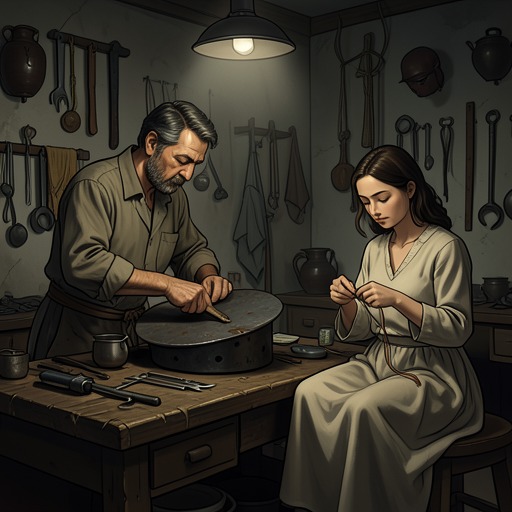
Hawberk’s connection with the Metropolitan Museum becomes concrete during the visit to his workshop. Constance works on embroidery while consulting a colored plate from the museum, an image that quietly joins domestic handiwork to the institution’s visual archive. The plate supplies a pattern for her work, while Hawberk’s professional knowledge supplies the historical account of the armor under repair.
The object occupying Hawberk’s attention is the missing greave of a famous suit. A client had traced it to a small shop in Paris on the Quai d’Orsay, after which Hawberk negotiated for and secured it. With the greave recovered, the suit is complete. The repair is thus both physical and historical: a fragmented object has been restored, and a chain of ownership extending from 1450 through successive owners to Thomas Stainbridge can once again be understood as belonging to a whole.
Hawberk’s persistence is especially significant because the search continued without certainty that the greave still existed. His cool response to that uncertainty defines collecting as an act of faith in material survival. The missing piece may have been lost, but the possibility of its recovery justified sustained investigation. In this respect, the museum’s world is governed by patience, provenance, and the conviction that the past remains recoverable through objects.
Public Culture and Private Collecting
The Metropolitan Museum occupies a boundary between public institutional culture and private accumulation. Hawberk is responsible not only for the museum’s armor treasures but also for several collections belonging to wealthy amateurs. His professional authority circulates between these spheres, making the museum a standard against which private collections can be assessed while also allowing private owners to command specialized scholarly labor.
This arrangement gives historical objects a double identity. They are cultural artifacts preserved within a public institution, yet they are also commodities sought by affluent individuals and purchased through international networks. The Parisian recovery of the greave shows how the museum’s expertise extends beyond its walls: its knowledge is mobilized in workshops, shops, private collections, and negotiations across national borders.
Narrative Significance
The Metropolitan Museum is one of the narrative’s stabilizing institutions. Against the frightening imaginative power associated with The King in Yellow, Carcosa, and the Pallid Mask, the museum stands for classification, material continuity, and a recoverable past. Its presence in the armor episode gives historical objects a firm context even as the surrounding story repeatedly questions the reliability of perception and interpretation.
At the same time, the museum is not detached from obsession. The recovered greave attracts prolonged searching, specialized attention, and intense interest in minute physical details. Its collections demonstrate that orderly scholarship and passionate fixation can coexist. The institution’s significance consequently lies in this tension: it preserves history through disciplined expertise, while the desire to complete and possess the past can become as consuming as any darker fantasy in the book.